
Background
The Divisional Forest Office, Tsirang established in 1988 delivers forestry services to 12 gewogs and 101 villages of Tsirang Dzongkhag, covering an area of 637.83 km² with an elevation range from 250–3,000 masl. The office is strategically located above Tsirang–Thimphu National Highway under Kilkhorthang Gewog, operating from a two-storey office building on 9.8 acres of forested land. Following the establishment of the Dagana Forest Division in November 2016, the division’s jurisdiction was streamlined to focus solely on Tsirang Dzongkhag.
Ecologically, the division plays a critical role in maintaining landscape connectivity through Biological Corridor–03 (BC-03), linking Phibsoo Wildlife Sanctuary, Royal Manas National Park, and Jigme Singye Wangchuck National Park, thereby supporting vital wildlife movement and landscape connectivity. The area is predominantly covered by Warm Broadleaved Forests, followed by Sub-Tropical and Cool Broadleaved Forests, and hosts rich biodiversity with 213 bird species, 126 tree species, 38 mammal species, and 16 fish species highlighting its ecological importance and conservation value within Bhutan’s forest landscape. The office manages 15.52% of Biological Corridor–03 (BC-03) across two gewogs, and oversees 49 Community Forests (CFs), 5 Local Forest Management Areas (LFMAs), and 9 Private Forests (PFs). The jurisdiction also includes one Key Biodiversity Area (KBA) of significant ecological importance.
Vision
Sustaining Bhutan’s forest resources and biodiversity for the happiness of present and future generations.
Mission
To conserve and manage Bhutan’s forest resources and biodiversity to ensure social, economic, and environmental well-being, and to maintain a minimum of 60% of the land under forest cover for all times to come.
Mandates
- Uphold Bhutan’s constitutional requirement of maintaining a minimum of 60 percent forest cover at all times, ensuring the preservation of ecological integrity, watershed stability, and environmental sustainability.
- Ensure the sustainable management and utilization of forests, biodiversity, and water resources to maintain ecosystem health, productivity, and resilience for present and future generations.
- Conserve and protect important flora and fauna species and their habitats, including those located outside the protected area network, through effective conservation measures and habitat management.
- Promote and implement scientifically sound silvicultural practices to enhance forest regeneration, productivity, and sustainable forest resource management.
- Safeguard forests and natural resources from pests and diseases, forest fires, encroachment, illegal activities, and unsustainable developmental interventions through strengthened protection, monitoring, and enforcement mechanisms.
- Ensure timely and efficient delivery of forestry services and facilitate access to forest products such as timber, fencing poles, flag posts, firewood, bamboo, leaf mould, sand, stone, and other minor forest produce for both rural and commercial needs in accordance with established rules and regulations.
- Implement strategies and interventions to reduce human–wildlife conflict, while promoting community participation and enhancing sustainable livelihood opportunities through responsible natural resource management.
Under the Chief Forestry Officer, it houses three technical sections, namely the Nature Conservation Section (NCS), Forest Resources Planning and Management Section (FRPMS), and Forest Monitoring and Information Section (FMIS), along with one Administration Section. These sections are further supported by three Range Offices and one Forest Beat Office.
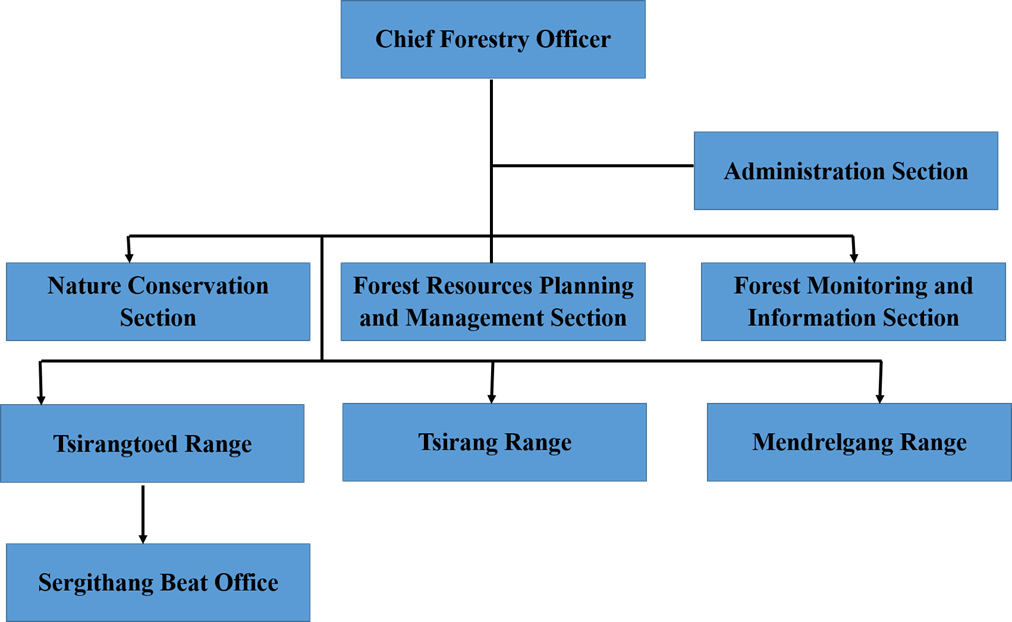 |
The Tsirang Range Office, located within the divisional campus provides services to Kikorthang, Rangthaling, Tsholingkhar, Gosaling, Dunglagang, and Semjong gewogs. The Mendrelgang Range Office serves Mendrelgang, Barshong, and Patshaling gewogs. Similarly, the Tsirangtoe Range Office caters to Sergithang, Phuntenchu, and Tsirangtoe gewogs, supported by the Sergithang Beat Office to strengthen field coordination and outreach. Strategically located across the gewog centre, these offices facilitate the efficient delivery of forestry services, including resource management, biodiversity conservation, and sustainable natural resource management. The Division is further supported with one pool vehicle and three motorbikes to enhance field mobility and service delivery.
Despite ongoing conservation efforts by the Division, forests and wildlife resources continue to face persistent threats. Habitat degradation resulting from developmental activities, uncontrolled grazing, and forest fires remains a major concern. In addition, illegal wildlife poaching, increasing human–wildlife conflicts, and the impacts of natural calamities further exacerbate the challenges to sustainable forest and biodiversity conservation.
Contact details:
Phone: +975-06-471117/471424
Email: tsirangforestdivision119@gmail.com
Facebook: https://facebook.com/Tsirangforestdivision

